
 中文
 English
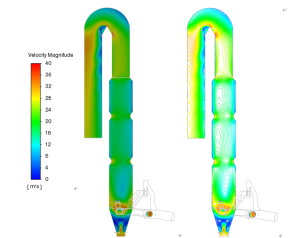
Cement manufacturing demands highly integrated, optimized design that unites fluid mechanics and chemical reaction systems.
To achieve superior operational performance for new projects and lower clients’ upfront capital expenditure concurrently, we deploy cutting-edge Computational Fluid Dynamics (CFD) and process simulation technologies. We continuously refine our methodologies throughout project delivery. Especially when dealing with block-type secondary fuel combustion inside industrial kilns and plant technical retrofits, we deliver guaranteed optimized performance and maximum equipment uptime.
Our engineering team collaborates closely with PERA Global, Nanjing University of Science and Technology, leading industrial research & design institutes, and Aixergee specialists. Leveraging hands-on experience accumulated across dozens of projects, we uphold premium service standards to ensure every project is delivered with exceptional quality.
Frequently Asked Technical Questions
Q1. What turbulence and multiphase models are used for CFD simulation of cement cyclone preheaters, and why?
Cement preheater cyclones operate with highly swirling, anisotropic turbulent flow at high solid loading (5–15 kg dust/kg gas). The industry-standard choice is the Reynolds Stress Model (RSM) for turbulence — k-ε underpredicts tangential velocity and overpredicts pressure drop because it assumes isotropic eddies. For multiphase, the Dense Discrete Phase Model (DDPM, Eulerian–Lagrangian) coupled with k-ω SST has been validated at DTU on a 1.6 m diameter industrial cyclone, matching measured pressure drop within ±8% and separation efficiency within ±5%. Particle tracking uses stochastic stochastic (random walk) dispersion, and particle size distribution is typically Rosin-Rammler with d50 ≈ 10–20 μm. Heat transfer is modeled via conjugate heat exchange between gas and discrete particles. Simulations typically require 5–10 million cells (hexahedral + polyhedral), 2nd-order upwind discretization, and 0.001 s time steps for transient vortex-core precession. FLSmidth and KHD both use this class of CFD to pre-screen cyclone geometry modifications before committing to steel fabrication.
Q2. How does CFD help optimize cyclone vortex finder (dip tube) geometry to reduce pressure drop without losing separation efficiency?
The vortex finder is the most sensitive geometric parameter. CFD DoE studies (e.g., PLOS One 2025 on cement kiln cyclones) show that reducing vortex finder diameter by 33% raises tangential peak velocity by 66% and separation efficiency by 3–5%, but increases pressure drop by 20–30% — a bad trade. Conversely, lengthening the vortex finder by 20% (from 0.5D to 0.6D, where D is cyclone diameter) improves efficiency by up to 5% while only adding ~3% pressure drop, because it short-circuits the short-circuiting flow directly from inlet to outlet. The optimal design couples a slightly widened inlet box (tangential entry with guide vanes) with a longer vortex finder. A Springer 2024 study found that streamlined bell-mouth inlet curvature on the vortex finder reduces pressure drop by 12–15% at matched efficiency. On a 5000 t/d C1 twin cyclone (each ~φ5.5 m), this translates to 80–120 Pa lower ΔP and ~150 kW less ID fan power — worth USD 100,000+/year.
Q3. What validation data is required to trust CFD results before cutting steel for a 5000 t/d preheater retrofit?
CFD must be validated at three scales. (1) Bench/lab: compare simulated pressure drop and collection efficiency against published standard cyclone datasets (e.g., Lapple, Muschelknautz) at low solid loading. (2) Cold model: build a 1:8–1:10 plexiglass model of the existing preheater, measure ΔP with inclined manometers and efficiency with isokinetic sampling, and re-mesh the CFD to match the exact model geometry — target error <10%. (3) Field baseline: use the plant's own thermal calibration data (C1 exit temperature 320 °C, measured ΔP per stage, measured C1 outlet dust 70 g/Nm³) as the boundary condition. Only after the baseline CFD reproduces measured data within ±10% pressure drop and ±15% efficiency do you trust the modified-geometry prediction. DTU's validation on a 1.6 m industrial cyclone achieved within 8% on ΔP. Never extrapolate CFD from a clean gas cyclone to a 5000 t/d preheater without accounting for solid loading — cyclone pressure drop plateaus above ~8 kg dust/kg gas, which flat-gas CFD misses entirely.
Q4. What does a CFD preheater optimization study cost, and how does it reduce retrofit trial-and-error?
A commercial CFD study covering 2–3 cyclone stages, 4–6 geometry variants, and full multiphase validation typically costs USD 15,000–40,000 and takes 4–8 weeks. The savings come from avoiding one wrong steel modification: a single C1 cyclone inlet box retrofit costs USD 80,000–150,000 to install, and if the design only saves 50 Pa instead of the predicted 150 Pa, the payback stretches from 1.5 years to 5+ years. CFD also identifies synergies — e.g., widening the inlet duct while lengthening the dip tube yields 2× the pressure-drop reduction of either change alone. The IJISRT study on a twin C1 cyclone found that adding a 250–300 mm baffle plate at the outlet duct optimized gas distribution between strings, cutting heat loss by 0.9–1.3% (equivalent to 588–722 billion Rupiah/year ≈ USD 40,000–50,000). For most 5000 t/d plants, a USD 25,000 CFD study that de-risks a USD 500,000 retrofit has immediate ROI.




Comments (0)