
 中文
中文 English
1Analysis of Original Production Status
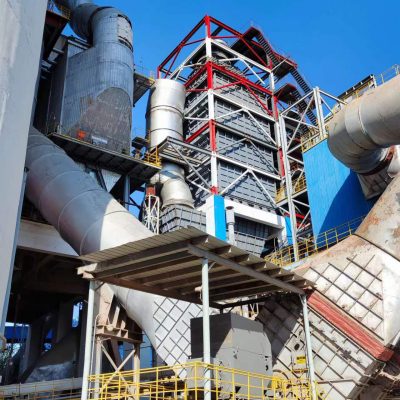
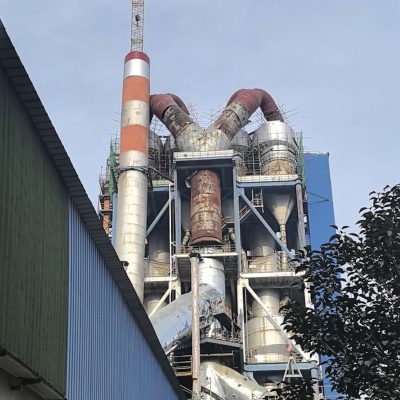
The clinker burning system of a subsidiary company under BBMG Jidong Group is equipped with core equipment manufactured by Jidong Equipment, including a five-stage double-string cyclone preheater, duct-type in-line calciner, Φ4.8×74 m rotary kiln and 4th-generation grate cooler. This production line was completed and commissioned in 2009. At present, its stable output stands at about 6500 t/d, with standard coal consumption of roughly 103 kg per ton of clinker, power consumption of the burning system at 28.72 kWh/t.cl, and overall clinker power consumption at 64.48 kWh/t.cl. To further boost production capacity, optimize energy consumption indicators, and ensure NOₓ emissions comply with national and local regulatory standards, a technical renovation is planned for the production line to achieve stable clinker output of no less than 6500 t/d. The renovation design adheres to the principles of economy and full utilization of existing facilities, minimizing project investment and maximizing economic benefits with the lowest possible input.
2 Current Status of the Burning System
2.1 Main Equipment Specifications and Parameters of the Burning System
表格
| Item | Unit | Model & Specification |
|---|---|---|
| Preheater | Model | 5-stage double-string pre-decomposition cyclone preheater |
| C1 Cyclone | mm | 4-Φ5000 |
| C2 Cyclone | mm | 2-Φ6900 |
| C3 Cyclone | mm | 2-Φ6900 |
| C4 Cyclone | mm | 2-Φ7200 |
| C5 Cyclone | mm | 2-Φ7200 |
| Calciner Body Diameter | mm | Φ7500 |
| Calciner Duct Diameter | mm | Φ5650 |
| Effective Volume of Calciner | m³ | Calculated based on 4-Φ5000 cyclone configuration |
| Rotary Kiln Size | m | Φ4.8 × 74 |
| Kiln Inclination | % | 4 |
| Rotary Kiln Rotation Speed | r/min | 0.396~4 |
| Rotary Kiln Motor Power | kW | 630 |
| Tertiary Air Duct Diameter | mm | Φ3200 |
| Grate Cooler | Model & Spec. | 4th-generation grate cooler |
| Grate Bed Area of Cooler | m² | 133.2 |
| Kiln Head Baghouse Dust Collector (Post-renovation) | Air Volume (m³/h) | 650000 |
| Kiln Head Exhaust Fan (Pre-renovation) | Air Volume (m³/h) | 700000 / 580000 |
| Total Pressure (Pa) | 2200 / 3200 | |
| Motor Power (kW) | 800 (upgraded to 1250 kW) | |
| Kiln Tail High-Temperature Fan (Variable Frequency) | Air Volume (m³/h) | 930000 / 850000 |
| Wind Pressure (Pa) | 7500 / 7800 | |
| Motor Power (kW) | 2800 |
(2) Raw Materials & Fuels
2.2 Main Technical & Economic Indicators Before Renovation
表格
| Item | Value | Item | Value |
|---|---|---|---|
| Designed Output (t/d) | 5000 | Actual Maximum Output (t/d) | 6500 |
| Raw Coal Consumption (kg/t.cl) | — | Standard Coal Consumption (kg/t.cl) | 103 |
2.3 Major System Deficiencies & Root Cause Analysis
- The overall resistance of the burning system is relatively high, and fan efficiency test results from different manufacturers show significant deviation. After the SCR system is added and production capacity is further raised, the high-temperature fan will face insufficient capacity. Without system technical renovation, the fan has to be replaced with a higher-efficiency model.
- The inherent resistance of the C1 cyclone reaches 1500 Pa. Its internal structure cannot adapt to high-air-volume operating conditions, featuring high inlet wind speed and low separation efficiency of approximately 92%.
- The staged combustion retrofitting leads to uneven pulverized coal distribution inside the calciner. In addition, the calciner volume is insufficient relative to the production load, resulting in incomplete coal combustion, excessively high CO concentration at the calciner outlet, inhibited SNCR denitrification reaction and excessive ammonia water consumption. NOₓ emissions cannot be controlled below 50 mg/Nm³.
- Co-disposal of hazardous waste constitutes another major factor causing drastic CO fluctuation and elevated emission concentrations. Fluctuations in hazardous waste composition, moisture content and calorific value directly destabilize the operation of the calciner and rotary kiln, which requires high priority attention.
- High coal consumption of the burning system is mainly attributed to excessive outlet temperature of C1 cyclone and incomplete combustion induced by high CO content. Excessive ammonia water dosage also pushes up overall heat consumption.
2.4 Comparative Calculation of Operating Parameters
Process parameters and production data are adopted to calculate the current operating indicators of the burning system as listed below:
表格
| Category | C1 | C2 | C3 | C4 | C5 | Calciner |
|---|---|---|---|---|---|---|
| Number of Cyclones | 4 | 2 | 2 | 2 | 2 | 1 |
| Operating Temperature (℃) | 325 | 520 | 680 | 780 | 870 | 880 |
| Operating Negative Pressure (Pa) | ~5600 | ~4100 | ~3400 | ~2300 | ~1450 | ~800 |
| Cross-Section Wind Speed of Cyclone (m/s) | 3.44 | 4.90 | 5.77 | 5.63 | 5.90 | 10.49 |
| Outlet Wind Speed (m/s) | 15.52 | 18.66 | 19.54 | 19.73 | 20.68 | 12.31 |
| Inlet Wind Speed (m/s) | 17.65 | 19.89 | 20.64 | 19.60 | 18.88 | — |
After the SCR denitrification system is installed, the total system resistance will increase by roughly 1000 Pa. Therefore, resistance reduction renovation for the preheater is necessary to cut overall power consumption. Moreover, the SCR system is highly sensitive to flue gas dust content. Thermal calibration data indicates the dust concentration at the C1 outlet is about 95 g/Nm³, exceeding the design baseline of 80 g/Nm³. Hence, targeted modification on the C1 cyclone is required to improve dust collection efficiency without substantial resistance increase.
3 Renovation Scheme for the Burning System
The renovation scheme is formulated on the basis of on-site inspection of existing equipment, pipeline fabrication and installation status, and full investigation of production process parameters. Theoretical calculation of key process parameters and CFD (Computational Fluid Dynamics) simulation results are integrated to ensure scheme reliability while avoiding over-engineering, so as to save capital investment and construction duration.
3.1 Calciner & Tertiary Air Duct
The structural parameters and calculated operating indicators of the existing calciner under current production load are shown as follows:
表格
| Item | Parameter |
|---|---|
| Main Body Diameter of Calciner | Φ7.5 m |
| Effective Height of Main Body | 30.51 m |
| Outlet Diameter | Φ5.65 m |
| Height of Gooseneck Duct | 35.3 m |
| Total Effective Volume | ~2100 m³ |
The existing calciner has an effective volume of around 2100 m³, providing a gas residence time of approximately 5.02 s under current output. Further capacity expansion demands calciner volume enlargement. This renovation makes full use of available space within the kiln tail frame. The pipeline diameter connecting the calciner to the C5 cyclone will be enlarged, and the elbow section will be raised by about 2 m. After modification, the calciner effective volume will increase by over 600 m³. A new anti-coking elbow structure is adopted to eliminate ash accumulation at the top elbow.
3.2 Cyclones & Connecting Ducts
Under the current 6500 t/d production load, the cross-section and inlet/outlet wind speed of each stage cyclone remain excessively high. To control preheater resistance after capacity increase:
- Expand the inlet area of C2~C5 cyclones and implement anti-ash-deposition renovation on inlets, with corresponding adjustment on connecting ducts.
- Add internal components and extend the inner cylinder of C1 cyclones to raise separation efficiency; moderately enlarge the C1 inlet area to reduce system resistance.
3.3 Kiln Hood
The cross-sectional area of the kiln hood constriction will be properly enlarged, with final dimensions confirmed after kiln shutdown inspection.
3.4 Denitrification System Optimization & New SCR Installation
Optimize and revamp the existing SNCR and staged combustion systems, followed by installation of a brand-new SCR denitrification system upon comprehensive evaluation.
List of Equipment Renovation Works for Burning System
表格
| No. | Renovation Item | Specific Work Content | Remarks |
|---|---|---|---|
| 1 | Preheater System | 1. Calciner volume expansion: enlarge pipeline diameter between calciner and C5 cyclone; optimize cone combustion system and replace coal injection pipelines; carry out matching modification on kiln tail frame | — |
| 2. Modify volute casing and inner cylinder of C1 cyclone plus add internal components | Core objective: improve dust separation efficiency | ||
| 3. Expand inlet area of C2~C5 cyclones and revamp connecting ducts accordingly | C1, C4 and C5 are included in this scope | ||
| 4. Enlarge the constriction section linking kiln hood and calciner | — | ||
| 5. Repair or replace material spreaders and flap dampers | Implemented by the owner based on original drawings if inspection confirms necessity | ||
| 2 | High-Temperature Fan | Theoretical calculation verifies the fan can meet operational requirements after overall system renovation | Fan replacement is temporarily not recommended |
| 3 | New SCR System | 1. Dismantle the original conditioning tower and reinforce its foundation to accommodate SCR reactor installation | — |
| 2. Renovate flue gas treatment system | — | ||
| 3. Install new SCR reactor plus matching inlet & outlet flue ducts | — | ||
| 4. Build supplementary flue gas conditioning & humidification pipeline system | — | ||
| 5. Upgrade ammonia injection system | — |
Key Performance Indicators After Renovation
After systematic upgrading, the clinker output can be stably maintained above 6600 t/d. The overall preheater resistance will drop by about 900 Pa, and NOₓ emissions will be controlled below 40 mg/Nm³.
表格
| Target Item | Pre-Renovation Baseline | Post-Renovation Target |
|---|---|---|
| Clinker Production Capacity | ≥6500 t/d | 6666 t/d |
| Standard Coal Consumption | ~103 kg ce/t.cl | ~101~102 kg ce/t.cl |
| Negative Pressure at C1 Outlet | ~5200~5300 Pa | ~4700~4800 Pa |
| C1 Outlet Flue Gas Temperature | 340 ℃ | 315 ℃ |
| C1 Cyclone Separation Efficiency | 93% | To be determined via field test |
| CO Concentration at C1 Outlet | <1000 ppm | <1000 ppm |
| NOₓ Flue Gas Emission | NOₓ<45 mg/Nm³ | NOₓ<40 mg/Nm³ |
| Comprehensive Denitrification Consumption | Ammonia water ≤3 kg/t.cl | Ammonia water ~2.0 kg/t.cl |
Benefit Estimation
1. Production Increase Benefit
The daily output rises by 200 t after renovation. Based on 200 operating days per year, the annual incremental clinker output reaches 40,000 tons. With a unit profit of 50 CNY per ton, the annual additional profit is 2 million CNY.
2. Coal Saving Benefit
Standard coal consumption is reduced by no less than 1 kg/t.cl (to be verified via inventory reconciliation). For an annual clinker output of 1.5 million tons and standard coal price of 1200 CNY/ton, the annual coal saving volume is 1500 tons, equivalent to an annual cost reduction of 1.8 million CNY.
3. Ammonia Water Saving Benefit
Ammonia water (20% concentration) consumption is cut by at least 2.0 kg per ton clinker. For 1.5 million tons annual clinker output and ammonia water price of 800 CNY/ton, the annual ammonia water saving quantity is 3000 tons, bringing an annual cost saving of 2.4 million CNY.
4. Power Saving Benefit
The system resistance is reduced by 900 Pa, and the total resistance reduction will exceed 1000 Pa after C2 & C3 cyclone modification. Theoretical calculation shows power consumption can be lowered by 1.15 kWh/t.cl. With annual clinker output of 1.5 million tons and electricity tariff of 0.6 CNY/kWh, the annual electricity saving is 1.35 million kWh, corresponding to an annual expense reduction of 1.035 million CNY.
5. One-Time Investment Saving
The replacement cost of the high-temperature fan is avoided, saving a one-time investment of 2.5 million CNY.
The high-temperature fan is calculated on a 10-year depreciation cycle. Summing up all above benefits, the total annual comprehensive benefit amounts to 7.485 million CNY. After deducting the annual SCR catalyst replacement cost of about 500,000 CNY, the annual net profit of the technical renovation project reaches 7 million CNY.



Comments (0)