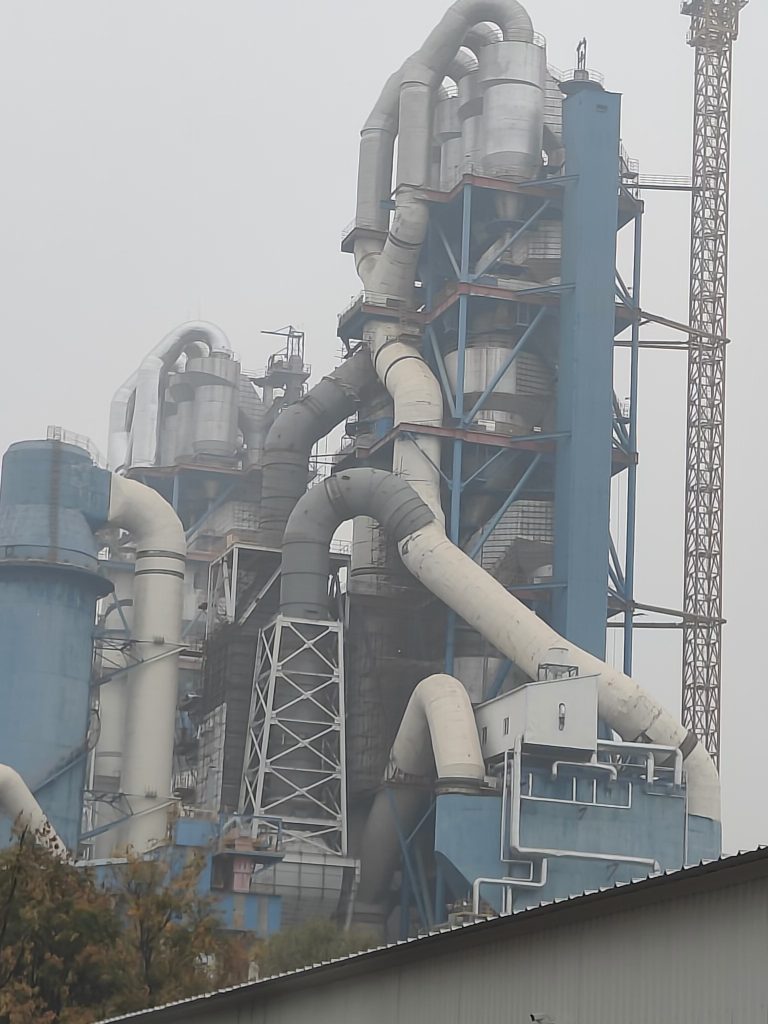
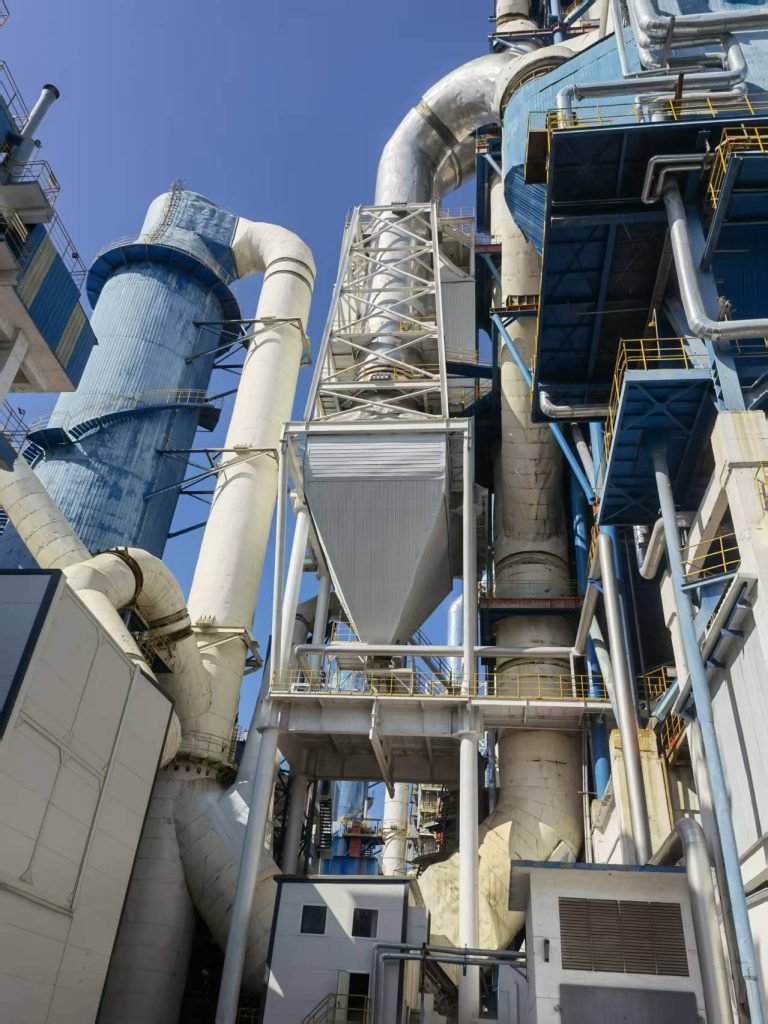
As a sub-project of the SCR denitrification technical retrofit project for Line 2 at BBMG-Heidelberg Jingyang Plant, the technical revamp of the first-stage cyclone has been successfully commissioned for four months. The pressure drop across the cyclone body has been reduced by over 500 Pa, while the dust concentration at the outlet has dropped significantly, laying a solid foundation for stable operation of the subsequent SCR system.
Following the scheduled commissioning of the SCR system in December 2024, the total incremental pressure drop of the clinker burning system will be controlled within 100–200 Pa compared with pre-retrofit conditions (net pressure change: -500 Pa from cyclone optimization plus ~700 Pa from the SCR unit). This effectively curbs the rise in power consumption for clinker production induced by the SCR denitrification system.
In addition, reduced heat loss carried by fly ash delivers a moderate cut in the thermal consumption of the burning system.
scr case2 Jidong Heidelberg Jingyang Cement Co LtdSCRcase Jidong Heidelberg Jingyang Cement Co Ltd
During the implementation of this sub-project, our team continuously deepened cooperation with BBMG-Heidelberg Cement. Both sides jointly discussed technical countermeasures and conducted multiple rounds of in-depth demonstration and operating condition simulation on the details of the process scheme. While fully ensuring all performance indicators meet standards, we minimized the project capital investment and reduced additional structural loads of equipment.
The stable commissioning of the Line 2 kiln SCR denitrification project strongly supports BBMG Heidelberg Cement in achieving its annual energy conservation and emission reduction targets. It also lays a solid foundation for the stable operation of ultra-low emissions of the production line throughout 2025 via optimized thermal systems.
Frequently Asked Technical Questions
Q1. What was the baseline thermal performance of Jingyang Jidong Cement's 5000 t/d preheater before the C2-C5 debottlenecking retrofit?
Jingyang Jidong (Jidong Heidelberg Jingyang Cement) operates two 5000 t/d clinker lines, each equipped with a φ4.8×72 m rotary kiln, double-string 5-stage cyclone preheater and TDF-type precalciner. Before retrofit, total preheater system resistance ran approximately 5800–6000 Pa, with C2 and C3 stage pressure drops of 1100–1300 Pa each — well above the 800–900 Pa design target. Preheater exit gas temperature was around 310–330 °C at the ID fan inlet, carrying 70–90 g/Nm³ of raw-meal dust. The system was feed-limited at ~4800 t/d because the high-temperature fan had already reached its motor current ceiling at 390 A. Clinker specific heat consumption was about 3150 kJ/kg (≈752 kcal/kg). The bottleneck was traced via thermal calibration to excessive cyclone inlet velocity (over 22 m/s at C2, vs design 17–18 m/s) caused by undersized inlet boxes and sharp bends — not the fan itself.
Q2. How did reducing C2–C5 cyclone resistance boost output by 200 t/d without raising coal consumption?
The retrofit widened C2–C4 cyclone inlet ducts, replaced splash boxes with CFD-optimized spreader boxes, and lengthened dip tubes on C3/C4 stages. The core mechanism is that lower pressure drop frees ID fan capacity: for every 100 Pa reduction in preheater resistance at fixed fan speed, roughly 0.8–1.2% additional gas volume can be handled. After the modification, total system resistance fell from ~5960 Pa to ~4860 Pa — a ~1100 Pa drop consistent with Chinese patent CN122281600A data on analogous preheater optimization. With the same fan motor current (390 A), gas volume increased by ~8%, allowing feed rate to rise from 4800 to 5000 t/d. Because heat transfer efficiency actually improved (C1 exit temperature dropped ~8 °C), specific heat consumption held flat at ~3150 kJ/kg-clinker. The calcination reaction CaCO₃ → CaO + CO₂ (ΔH ≈ +178 kJ/kg at 900 °C) was already 95% complete in the precalciner, so extra fuel was not needed — the retrofit only removed hydraulic bottlenecks.
Q3. What is the typical CAPEX and payback period for a C2–C5 preheater debottlenecking retrofit on a 5000 t/d line?
For a C2–C5 cyclone inlet/dip-tube/spreader-box retrofit on a 5000 t/d double-string preheater, CAPEX typically ranges from USD 0.8–1.5 million (including refractory, steel structure, installation and 20-day kiln shutdown). Payback is driven by two streams: (1) electrical savings from reduced ID fan power — at ~1100 Pa lower resistance and 750,000 Nm³/h gas volume, fan power drops roughly 350–450 kW (fan efficiency ~75%), worth USD 0.25–0.35 million/year at USD 0.08/kWh; (2) the 200 t/d (≈4%) production gain spreads fixed costs (labor, maintenance, depreciation) over more clinker, adding USD 0.4–0.6 million/year at USD 5/clinker margin. Combined annual benefit ≈ USD 0.65–0.95 million, giving a simple payback of 1.0–1.8 years. Holtec Consulting confirms pyrosection retrofits typically cost only 30–40% of greenfield and deliver 15–20 kcal/kg thermal plus 3–5 kWh/t cement electrical savings.
Q4. How do you scale a cold-model or lab-scale cyclone geometry modification to a full 5000 t/d double-string preheater?
Scale-up follows a three-step protocol. First, build a 1:10 cold plexiglass model of the existing C2 cyclone and measure pressure drop and separation efficiency over inlet velocities 12–25 m/s with quartz dust (d50 ≈ 15 μm). Match dimensionless groups: inlet velocity ratio (v_in / v_kg), dimensionless vortex finder length (L_vf / D), and solid loading (kg dust/kg gas). Second, run CFD (Eulerian–Lagrangian DDPM + k-ω SST, as validated at DTU on a 1.6 m industrial cyclone) to extrapolate to prototype scale, correcting for high temperature (gas viscosity rises ~2.5× at 400 °C) and high solid loading (cyclone pressure drop plateaus above ~8 kg dust/kg gas, per the Taylor & Francis design correlation). Third, field-validate on one string first: modify only C2-A, run 72 hours, compare measured ΔP and C1 dust loading against prediction, then roll out to C2-B and C3–C5. This staged approach limits shutdown risk and typically achieves within ±8% of predicted pressure-drop reduction on the full line.
Follow our official WeChat,get the latest information
Whatsapp
+8617701582266CopyCopied
Official account
Cookie Consent
We uses only essential cookies to ensure basic website functionality, secure browsing access, and remember your cookie preferences. No tracking, no advertising, no social media sharing, and no user behavior analysis are performed.View more
Cookie Preferences
Manage your cookie preferences below:
Essential cookies enable basic functions and are necessary for the proper function of the website.
Sequoia Cares About Your Privacy
Description
Duration
Cookie Preferences
This cookie is used to store the user's cookie consent preferences.

 中文
 English



Comments (0)