1. Project Background
Conventional transfer lines for Solid Recovered Fuels (SRF) alternative fuels rely mainly on manual feeding. Imperfect manual operation and inadequate equipment often lead to uncontrolled fugitive dust dispersion, filling the workshop and plant with combustible dust. In contrast, automated equipment enables precise containment of dust emissions via fully enclosed conveying and unloading machinery to eliminate dust leakage. Furthermore, negative pressure control technology is deployed during operation to extract and capture dust at source, minimizing worker exposure hazards and mitigating on-site fire and explosion risks.
2. Solutions from Sequoia
2.1 Applicable Feedstock Types
- Biomass
- Wood chips / Wood lumps post primary crushing
- Straw
- Rice husks
- Alternative Fuels / SRF (Solid Recovered Fuels)
2.2 Design Principles
- The silo can receive feedstock at a designated feeding rate (X t/h) while discharging the same material at a separate output rate (Y t/h) simultaneously.
- Material follows the First-In, First-Out (FIFO) flow principle.
2.3 Main Equipment Components
- Floor Module
a. Drive Unit
b. Inclined Protective Shield
- Spike Rolls
a. Bearings
- Leveling Screw Conveyor
a. Supports & Bearing Assemblies
- Gear Motors
- Rotational Speed Sensors
- Radar Level Sensors (Millimeter-wave Type)
- Support Legs & Wind Bracing
- Silo Wall Panels
- Maintenance Access Door
- Leakage Collection Trays
- Hydraulic Power Unit (HPU)
- Fire Suppression System
2.4 Component Descriptions
2.4.1 Drive Unit
Bottom-mounted drive assembly for walking/moving floor operation
2.4.2 Spike Rolls
We develop multiple customized spike roll configurations to match diverse conveying feedstock characteristics.
2.4.3 Bearings
Premium bearings from SKF, NSK and Timken are adopted to extend the overall service life of the whole system.
2.4.4 Hydraulic Power Unit (HPU)
HPU supplied for the Maanshan Project in partnership with CRCC.
This hydraulic power unit converts electric power into hydraulic power using ISO VG46 mineral hydraulic oil (viscosity: 46 mm²/s @ 40°C). The load-sensing axial piston pump and matching driving motor are mounted on a detachable top cover alongside the valve manifold. The manifold integrates on-off valves and proportional DC valves to regulate oil flow and adjust system operating speed.
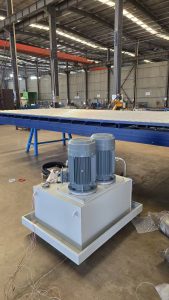
moving floor drive unit
We deliver custom hydraulic station designs with waterproof, dust-explosion-proof and gas-explosion-proof certifications.
2.4.5 Ongoing Projects
2.4.6 Optional Leakage Collection Trays
Leakage trays capture most permeated leachate passing through the floor module, protecting support structures and surrounding areas from contamination.
The trays feature a steel framework lined with polyethylene sheets; adjacent polyethylene panels are welded with targeted inclinations to guide leaked solids and liquids to the drainage network.
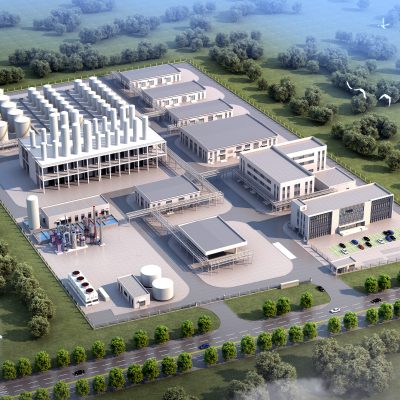
3. Integrated Silo & Dust Removal Engineering Practice
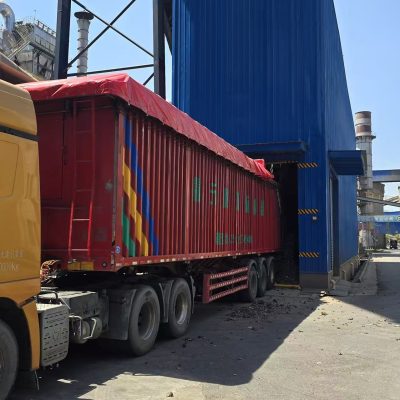
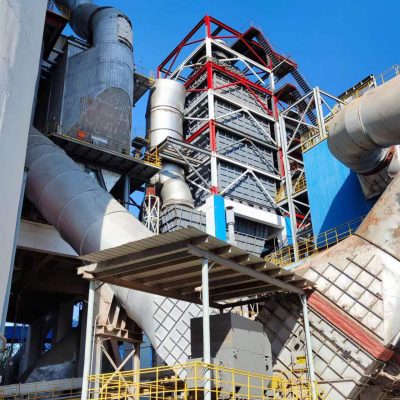
For the Maanshan project, we implemented an innovative integrated silo-dust removal system design, limiting dust emission concentration to below 10 mg/Nm³.
In addition, compact structural layout realizes full integration of unloading, silo storage, discharging and dust abatement equipment within a minimal footprint.
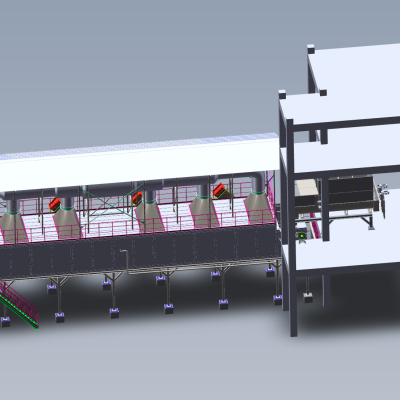
The corresponding process flow diagram is shown below.
This innovative integrated silo and dust removal system has also been applied in our latest construction projects, guaranteeing outlet dust concentration below 10 mg/Nm³. The compact layout consolidates unloading, silo storage, discharging and dust treatment units to save significant floor space.
4. Summary
Selecting a well-matched material handling system greatly improves overall plant operational efficiency. Our silo solutions deliver cost-effective, low-maintenance storage and conveying performance for all your bulk material handling requirements.
Frequently Asked Technical Questions
Q1. Why does a moving floor bunker handle fluffy RDF and biomass that bridges in a conventional conical silo?
Alternative fuels such as shredded RDF, wood chips and tire chips are fibrous, elastic and low in bulk density (typically 0.15-0.35 t/m3 for fluff, 0.50-0.55 t/m3 for tire chips per Saxlund’s Castle Cement reference), so they form arches and ratholes in hopper-bottom silos. A moving floor solves this by replacing the cone with a horizontal ‘live’ floor made of hydraulically driven steel slats that oscillate in alternating strokes, pushing the entire stored column toward a downstream scraper chain. Because extraction occurs over the full floor area rather than a small outlet, material flows en masse regardless of fiber content. Westeria rates its MovingFloor for light (up to 0.3 t/m3), medium (0.6 t/m3) and heavy (1.2 t/m3) bulk densities, covering everything from fluff to coarse tire-derived chunks. An optional leveling roller homogenizes the pile and guarantees a constant extraction rate even when the bunker is completely filled.
Q2. What storage volume and filling rate should be specified for a cement-plant AFR bunker?
Engineering practice sizes the bunker for 3-7 days of kiln demand at the target thermal substitution rate. For a 5000 t/d clinker line burning roughly 11-12 MJ/kg clinker, fuel demand is about 70 t/h of coal equivalent; at 60% substitution with RDF of LHV 17 MJ/kg and bulk density 0.25 t/m3, you need roughly 18-22 t/h of RDF, or about 1,300-1,600 t of RDF for a 5-day buffer. At a working filling rate of 85-90% (leaving 10-15% for truck dumpers, aeration and pile slope), that translates to a floor volume of roughly 5,500-7,000 m3. Bunkers are usually built as drive-over halls with floor widths of 4-8 m and lengths of 20-40 m; the Tong TP11 dosing bunker, for example, uses a 2.4 m x 11 m floor giving 32 m3, scaled up in modular sections to multi-thousand m3. The pusher floor itself occupies only the discharge end (typically 6-12 m of length), while the rest is a static storage pad.
Q3. How are fire and explosion risks managed when storing RDF and wood chips in a moving floor hall?
RDF dust and fine wood particles form explosive atmospheres, so the hall is designed to ATEX 2014/34/EU and 1999/92/EC requirements. The operating principle is to keep the flammable gas/dust concentration below 25% of the lower explosion limit (LEL) at all times, using a slight negative pressure of 30-60 Pa maintained by exhaust fans, with 90% of the filtered air recirculated back to the dryer/hall inlet. Dust extraction hoods at the floor discharge and at the weighfeeder interface capture fugitive dust before it can accumulate. Self-heating is monitored with distributed temperature cables; stored RDF with moisture above 20% and LHV above 16 MJ/kg must be turned within 7-10 days to prevent aerobic heating above 60 degC. Explosion venting panels or suppression barriers are installed on the bunker discharge conveyor, and the hydraulic power pack is located outside the classified zone.
Q4. How does the moving floor interface with the downstream gravimetric dosing system at the kiln?
The moving floor discharges onto a closed scraper chain conveyor that feeds a buffer hopper above a PFISTER-type rotor weighfeeder. FLSmidth’s TRW-S/D pneumatic conveyor handles processed RDF, wood chips and rice husk at up to 6 t/h as standard, with up to 30 t/h per TRW-S/D unit and up to four units installed under a single silo; the DRW 4.10 weighfeeder achieves a 1:100 turndown from 60 kg/h to 6 t/h, as proven at Schwenk Mergelstetten after 10 months of operation. The moving floor runs intermittently on a level-control signal from the buffer hopper, so the weighfeeder always sees a stable head of material and delivers mass-flow accuracy of +/- 1-2%. This two-stage arrangement (live floor for storage, gravimetric feeder for dosing) decouples the chaotic bulk flow of RDF from the precise mass balance the calciner requires, enabling thermal substitution rates above 60% without kiln instability.
An expert in pyroprocess and solidwaste recovery . Responsible for the Marketing and Support of Sequoia Industrial with over 14 years in this field. I am determined that our sustainable products and services will be at the forefront of the solution for the generations to come.

 中文
 English




Comments (0)