
 中文
中文 English
I. Industry Background & Existing Challenges
1. Using alternative fuels is a must for cement plants to achieve low-carbon transformation
Breakdown of carbon reduction approaches and their contribution ratios:
- Raw material decarbonization: 14%
- Alternative fuel application: 30%
- Thermal efficiency improvement: 9%
- Low-carbon clinker production: 8%
- Clinker replacement: 24%
- Energy efficiency upgrade plus renewable energy adoption: 11%
- Low-carbon concrete preparation: 28%
- Building structure optimization: 54%
- Carbon mineralization curing: 14%
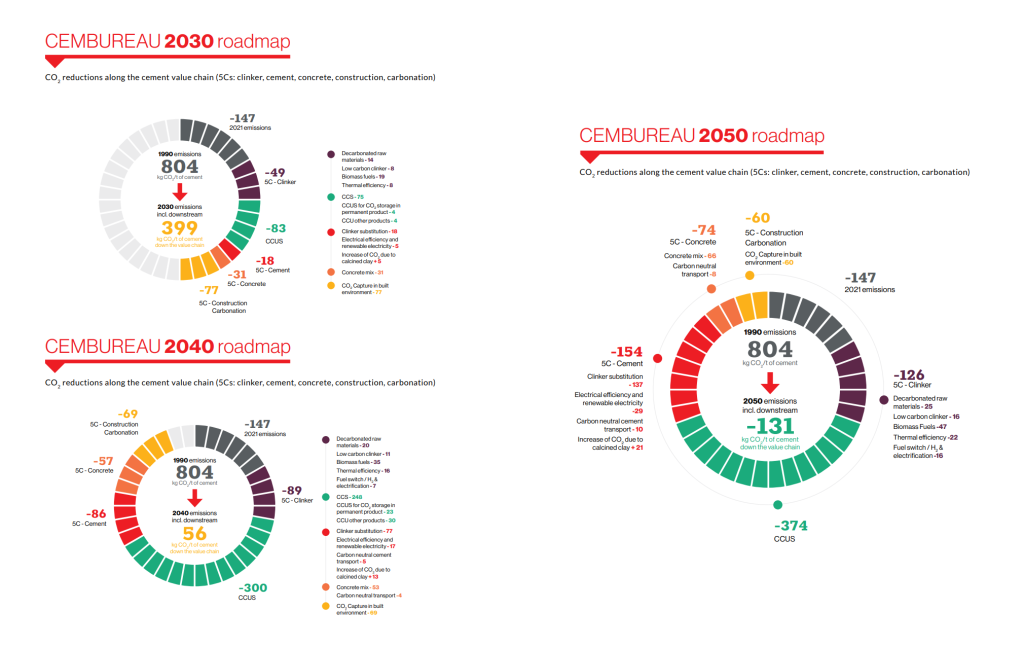
cembureau-net-zero-roadmap-2050
2050 Carbon Reduction Roadmap
Baseline carbon emissions set in 2017: After cutting 116 units of emissions, the baseline emission figure stands at 667 kg.
5C Clinker (Total emission reduction: 160 units)
- Raw material decarbonization: 27 units (an extra 13 units of reduction on top of the 2030 target)
- Biomass fuel usage: 71 units (an extra 41 units of reduction on top of the 2030 target, shifting from regular alternative fuels to biomass fuels)
- Thermal efficiency optimization: 28 units (an extra 17 units of reduction on top of the 2030 target)
- Low-carbon clinker production: 17 units (an extra 9 units of reduction on top of the 2030 target)
- Hydrogen energy and electrification retrofits: 19 units (all 19 units are new reductions beyond the 2030 benchmark)
5C Cement (Total emission reduction: 117 units)
- Clinker replacement: 72 units
- Energy efficiency improvement and renewable energy deployment: 35 units
- Low-carbon transportation for finished products: 10 units
5C Concrete
- Concrete formula adjustment: 52 units
- Low-carbon transportation links: 7 units
5C Building Projects
- Whole building carbon reduction: 51 units
- Carbon capture, utilization and storage (CCUS): 280 units
2. Major industry headache: heavy dust generated during alternative fuel pre-treatment
When crushers break down cotton, wool, linen, synthetic fiber and other fibrous waste materials, sand, grit and short lint separate from raw materials and form fibrous dust. This type of dust has three obvious traits:
2.1 High fiber content
Most fibers contained are irregular in shape.
2.2 Huge variance in particle size
The dust mixes long fibers, cotton scraps and fine dirt, leading to a wide range of particle sizes. Floating lint and loose fiber fragments range from several millimeters to tens of millimeters long, while ultra-fine dust particles are mostly smaller than 5μm. Such a broad size distribution requires dust removal systems to handle different particle fractions separately.
2.3 Strong adhesion
Fibers have natural twists along their length. Once fibers come into contact with one another, friction and intermolecular force make them tangle and stick together easily. When fibers cling to filter surfaces, they will block filter area and weaken dust collection effect. If fiber buildup accumulates inside pneumatic conveying pipes, it clogs pipelines or forms bulky deposits that stop material flow entirely.
3. Common operational pain points across the sector
- Traditional bag filters cannot adapt well to working conditions and deliver poor dust removal results, failing to meet on-site occupational health requirements.
- Workshops hold high concentrations of flammable dust, posing severe fire risks.
- Poor on-site working conditions fail inspection requirements from environmental supervision authorities.
- Large volumes of dust escape at material transfer points; simple covered sheds cannot contain dust leakage.
- Dust collection points are not fully laid out across material opening, unloading and conveying sections.
- The equipment lacks automatic control components. The supporting software cannot match actual dust removal process demands, leading to unstable negative pressure inside the system and unnecessary power waste.
- Improper design for air intake openings, ventilation ducts and wind speed parameters.
3.1 Main dust generation points
- Unloading bays inside general solid waste workshops
- Drop-off positions of belt conveyor transfer points
- Crusher feeding and discharging outlets
- Discharge end of air separation equipment
3.2 Core strengths of Sequoia
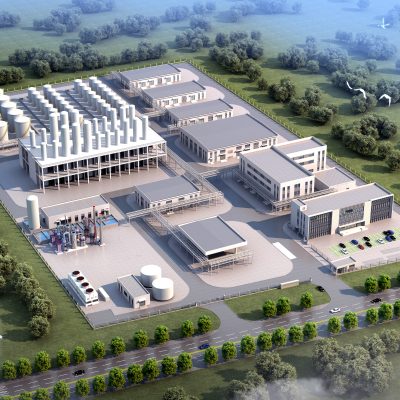
We can design and deliver full-set dust abatement solutions tailored for entire workshops.
4. Drawbacks of conventional bag dust collectors
Bag filters easily get clogged with dust, which raises overall system resistance and makes ash cleaning extremely difficult. Clogged bags weaken air suction capacity, leaving thick dust piled up on workshop floors. This dust cannot settle naturally by itself. Workers have to manually poke and clear blockages, which stirs up massive dust clouds around the equipment and pollutes the whole plant area.
II. Solutions Provided by Sequoia
1. Design & Compliance Specifications
- Hygienic Standard for Industrial Enterprise Design (GBZ1-2002)
- Code for Design of Cement Kiln Co-processing Industrial Solid Waste (GB 50634-2010)
- Standard for Pollution Control on Storage and Landfill of General Industrial Solid Waste (GB18599)
- Code for Design of Heating, Ventilation and Air Conditioning of Industrial Buildings (GB50019-2015)
- Design Specification for Electrostatic Earthing in Chemical Enterprises (HG/T20675)
- Technical Regulation for Ventilation Ducts
- Technical Specification for Deodorization of Municipal Sanitation Facilities
- Technical Requirements for Baghouse Dust Collectors (GB/T6719)
- Safety Code for Prevention and Control of Dust Explosion (GB 15577)
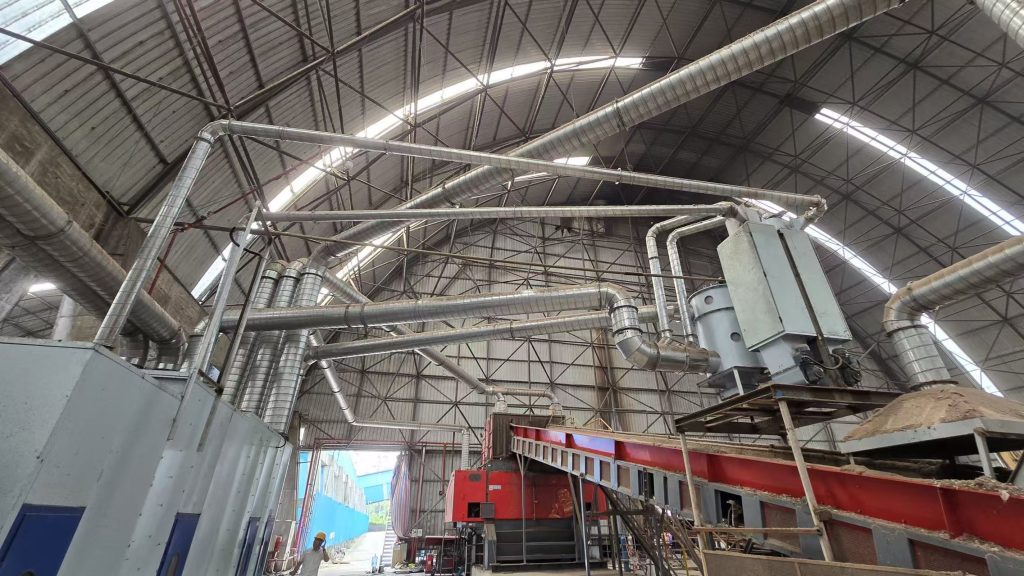
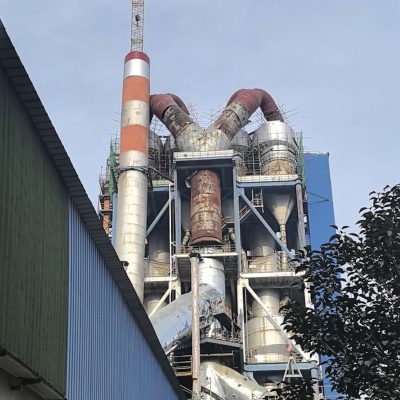
SRF dust removal system in Guangdong huizhou guangda Cement
2. Working Principle & Process Flow
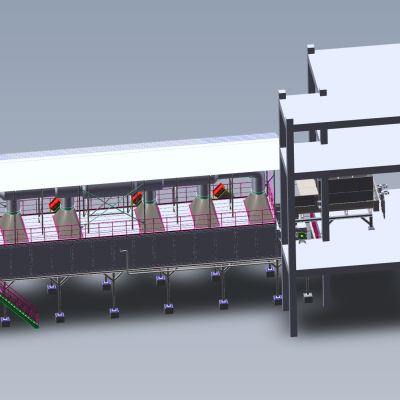
The main induced draft fan creates negative pressure inside the dust chamber and pulls dusty airflow into the dust removal unit. First, airflow passes through a primary disc pre-filter. Long fibers and large impurities are trapped on stainless steel filter screens. A rotary suction nozzle powered by a dedicated fiber exhaust fan sucks off accumulated fibers and debris, which go into a fiber separator for separation and compression before being discharged. Air carrying tiny leftover dust flows back into the primary filter cabinet.
Fine dust then moves through the filter screen and enters a secondary multi-cartridge dust filter. Clean air passes through plush filter cartridges and is discharged outdoors. Fine dust stuck on the filter cartridge surface is drawn away by a rotary suction nozzle driven by a reciprocating lead screw and sent into a brush cage dust collector for gas-solid separation. Dust is compressed and discharged via a dust compactor. Air separated in this step passes through a filter bag and flows back to the secondary cabinet. This structure prevents plush filter clogging and ensures steady continuous operation. Fully purified air is vented outside through filter cartridges.
III. Product Advantages
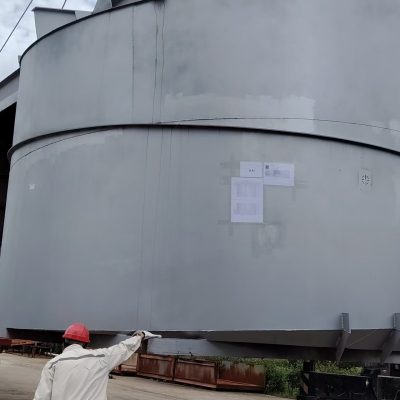
- Dust removal equipment can be custom-built according to actual on-site working conditions.
- We offer customized configuration for PLC systems, driving motors and spark detection modules, with options for top international brand parts.
- We adjust dust treatment schemes based on different material properties, update equipment and filter materials in a timely manner, and respond to client needs promptly.



Comments (0)