
 中文
中文 English
1. Status of Conventional Technologies
At present, the mainstream calcination technologies for non-metallic minerals include vertical kilns, rotary kilns, updraft kilns, tunnel kilns, pusher kilns and others. These calcination processes are difficult to operate in strict accordance with the optimal heating and cooling curves of minerals, which fails to fully exert the application properties of crystal phases. Such processes are plagued by low production efficiency, high energy consumption and unstable product quality.
Take the rotary kiln calcination process for limestone, which is widely adopted domestically, as an example. Products from this process feature relatively desirable performance and stable system operation. Firstly, limestone particles with a particle size of 10~60 mm are preheated to approximately 800 °C via a dedicated vertical preheater, achieving a limestone decomposition rate of around 30%. The preheated limestone is then fed into the rotary kiln for calcination, where complete decomposition of limestone is realized under high temperature of roughly 1250 °C.
Nevertheless, the vertical preheating system is fed with granular materials, whose heat exchange efficiency is far inferior to that of powdery materials inside suspension preheaters. In addition, heat transfer within the rotary kiln mainly relies on inefficient radiative heat exchange, and excessive heat dissipation through the rotary kiln shell leads to extremely high overall system energy consumption.
Double-chamber kilns represented by Maerz kilns boast advanced technology and low heat consumption, yet they are limited by a relatively small economical single-line production capacity and substantial upfront investment.
2. Introduction to Suspension Calcination Process for Active Lime
This process consists of the following steps:
- Powdery raw material is fed into the top-stage preheater;
- The material is sequentially preheated by multi-stage cyclone preheaters;
- Preheated material is sent into the calciner for calcination;
- Calcined material is cooled in a cooling unit to produce highly active finished products. Meanwhile, ambient air passes through a high-efficiency indirect heat exchanger to form high-temperature flue gas, which is introduced into the calciner as combustion-supporting air for fuel combustion.
The calciner can operate on a single fuel or mixed fuels. The process flow diagram is shown below:
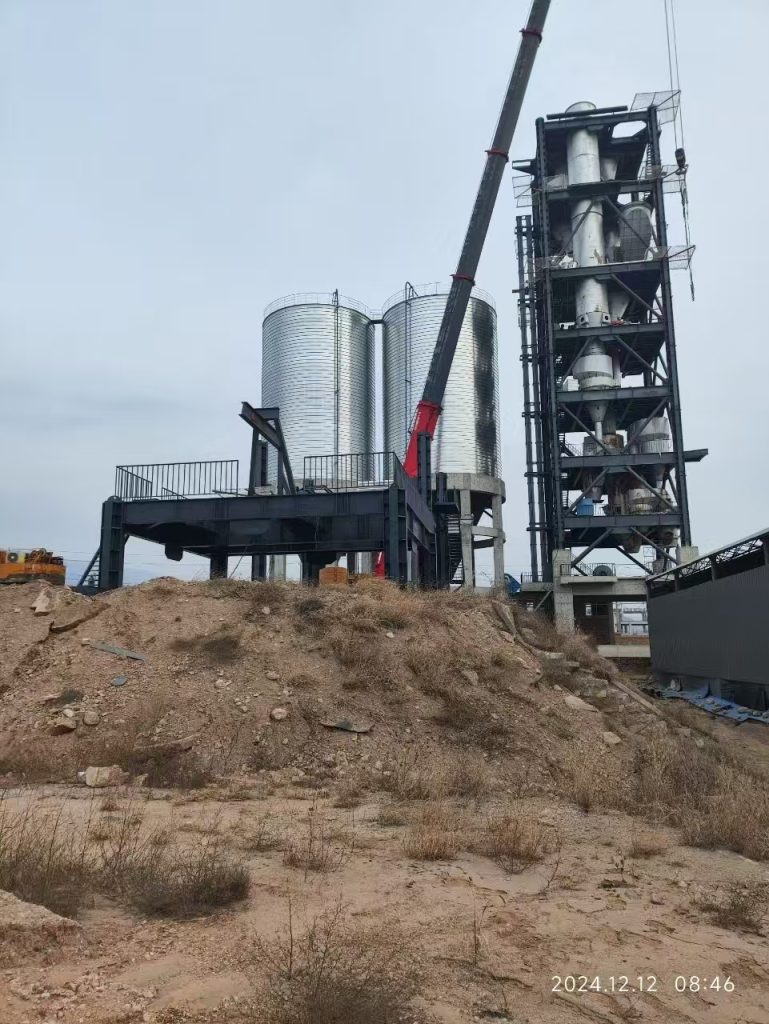
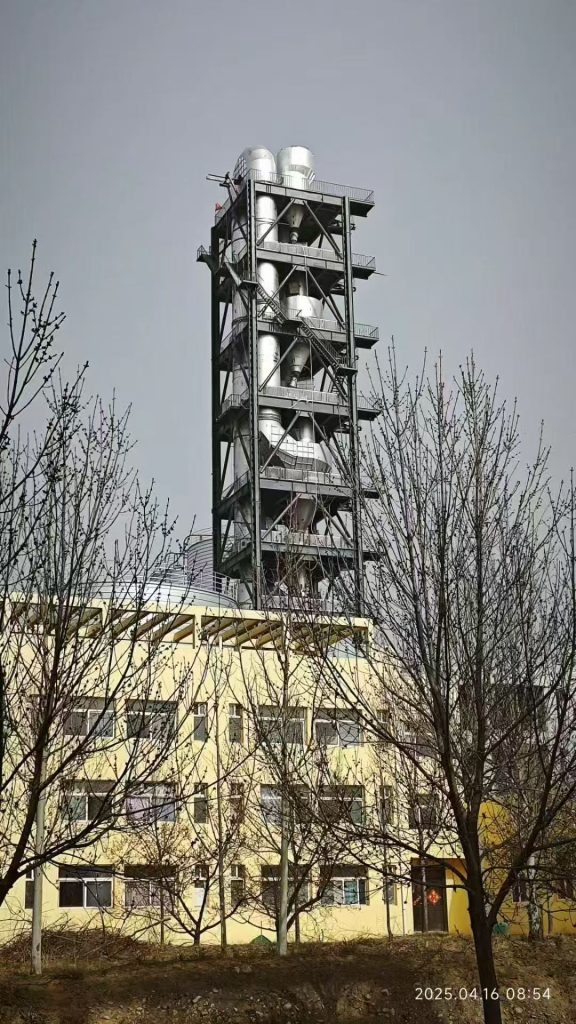
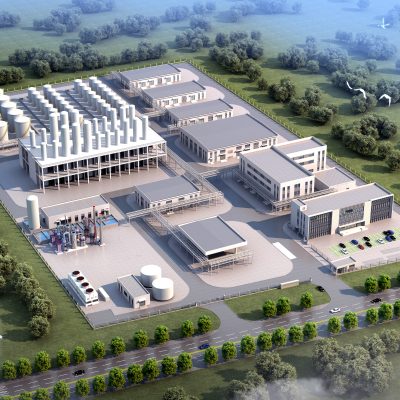
Process Flow Diagram of the Yuanping Project in Shanxi Completed by Sequoia
Project topped out in April 2025
3. Comparison of Core Technical Indicators
Key technical parameters of active limestone powder produced via suspension calcination are listed as follows:
- Heat Consumption: Direct biomass combustion < 1050 kcal/kg; biomass gasification ~ 1250 kcal/kg
- Power Consumption for Calcination Section: < 22 kWh/t (excluding coal grinding)
- Power Consumption for Grinding Section: Roller press system < 15 kWh/t; vertical roller mill system 18 kWh/t
- Calcium Carbonate Decomposition Rate: > 95%
- Lime Activity Index: > 320
- Particle Size of Calcined Material: 90% passing 200 μm sieve
- Investment for Clinkering and Cooling Section: Approximately RMB 30 million for a 1200 t/d production line (excluding steel frame and civil engineering works)
Both the suspension calcination process and rotary kiln coupled with vertical preheater can meet the design capacity of 1200 tons per day of active lime. However, the rotary kiln solution incurs higher capital investment and operating costs; a 1200 t/d lime rotary kiln requires a kiln shell diameter of no less than 4.8 meters. The proven economical capacity of double-chamber kilns stands at 600 t/d with considerable investment, and imported equipment alone costs around RMB 40 million.
Products from suspension calcination feature stable quality and high activity, which significantly improves the grade of iron ore sinter. Besides, the fineness of finished products perfectly satisfies the granulation requirements for sintering.
The power consumption of lime grinding in the calcination section can be controlled at 15 kWh/t, which is basically equivalent to the power consumption for lump lime grinding in sinter granulation and other industrial applications. If downstream users require powdery quicklime, the overall production cost will not increase when evaluating the full process route.
Furthermore, with increasingly stringent environmental protection regulations, a dedicated denitrification unit is mandatory for this process. Installing ammonia injection lances inside a rotary kiln for denitrification poses notable technical difficulties and operational risks. By contrast, suspension calcination represents more advanced technology with verified commercial operation cases at home and abroad, ensuring fully feasible implementation.
4. Fuel Options
If ash content does not compromise lime quality, the direct biomass combustion process is applicable, with a biomass feed rate of 8–10 t/h (calorific value: 3500–4000 kcal/kg).
Alternatively, a biomass gasifier can be deployed to generate pyrolysis gas. The gas yield ranges from 1000 to 1200 Nm³ per ton of biomass, with a calorific value of 1200–2000 kcal/Nm³ (gas output varies drastically among different gasification equipment), and the biomass consumption rate is 12–18 t/h. By-products from gasification can be processed and sold as carbon-based fertilizer. This route achieves ultra-low emissions with no need for additional desulfurization and denitrification end-of-pipe treatment facilities.
For a lime production capacity of 600 t/d, the required gas flowrate for the gasification system is 12,500 m³/h.
5. Biomass Preprocessing
Loose bulk density of raw biomass ranges from 0.1 to 0.3 t/m³, which demands large storage space and customized design for crushing and conveying systems.
To guarantee high-efficiency operation of the biomass gasification system, a dryer is required to reduce the moisture content of biomass. A waste heat boiler can be installed downstream of the suspension calcination system to generate steam and supply heat to the dryer. Flue gas exhausted from the boiler is reused as drying heat source for the grinding system to elevate overall energy utilization efficiency.
Please feel free to contact us if you require customized solutions for biomass drying and co-firing technologies.



Comments (0)