
 中文
中文 English
As one of the most consumed coffee products worldwide, instant coffee’s core manufacturing procedure — dehydration and concentration of coffee extract — exerts a direct impact on product quality and production cost. The competition between traditional thermal evaporation dehydration and emerging membrane separation technology is essentially a balance between product quality and economic benefits within the food industry.
I. Comparison of Technical Principles and Process Flow
1. Thermal Evaporation Dehydration
An evaporator heats coffee extract to above boiling point to evaporate moisture and produce high-concentration slurry, which is further processed into instant coffee particles via spray drying. This technology depends on high-temperature phase change (100–150°C) and requires continuous thermal energy input.
2. Membrane Separation Dehydration
Reverse Osmosis (RO) or Nanofiltration (NF) membrane modules are adopted to achieve selective dehydration under normal or low temperature with pressure difference and membrane screening effect. Water molecules pass through the membrane structure, while coffee solids, aromatic substances and macromolecular organics are intercepted. The concentrated liquor then enters the drying procedure.
II. Impacts on Coffee Quality
1. Retention of Volatile Substances
- Thermal Evaporation: High temperature causes a 30%–50% loss of key aroma components including aldehydes and esters, requiring additional flavoring agents to restore the original taste.
- Membrane Separation: Thanks to low-temperature operation, the retention rate of heat-sensitive substances such as terpenes and pyrazines exceeds 85%, making the finished product’s flavor profile much closer to freshly brewed coffee.
2. Variation of Non-Volatile Components
Thermal evaporation tends to intensify the Maillard reaction and generate bitter compounds including acrylamide.
With no heating process involved, membrane separation maintains the stability of functional ingredients like chlorogenic acid and trigonelline.
III. Energy Consumption Comparison
| Parameter | Thermal Concentration | Membrane Concentration |
|---|---|---|
| Operating Temperature | 60–80℃ | Ambient Temperature |
| Energy Consumption (kWh per ton of water removed) | 550–650 | 50–150 |
IV. Environmental Protection & Sustainability
Condensed water from thermal evaporation contains trace volatile organic compounds and must undergo biochemical treatment before discharge or reuse. Permeate from membrane separation nearly meets pure water standards and can be directly recycled or discharged.
V. Bottlenecks of Conventional Membrane Technology & Introduction to VSEP Technology
Membrane filtration is a sieving process determined by membrane pore size, driven by pressure difference across the membrane with the membrane serving as the filter medium. Under certain pressure, when stock solution flows across the membrane surface, tiny micropores on the membrane only allow water and small molecules to pass through as permeate. Substances larger than the membrane pores are trapped on the feed side to form concentrated liquor, thereby realizing separation and concentration of the raw feed liquid.
Classification of Membranes by Pore Size
Different membrane types deliver distinct separation performance for various substances:
- Microfiltration (MF): Permits macromolecules and dissolved solids (inorganic salts) to pass through, while intercepting suspended solids, bacteria and high-molecular colloids.
- Ultrafiltration (UF): Allows small molecules and dissolved inorganic salts to permeate, retaining colloids, proteins, microorganisms and macromolecular organics.
- Nanofiltration (NF): Rejects 20%–98% of dissolved salts, with lower removal efficiency for monovalent soluble ions than multivalent ions.
- Reverse Osmosis (RO): Effectively intercepts all dissolved salts as well as organic and inorganic substances with molecular weight above 100 Daltons.
Membrane Fouling Definition
Membrane fouling refers to irreversible deterioration in permeate flux and separation performance caused by adsorption and deposition of particles, colloids or macromolecular solutes on membrane surfaces or inside membrane pores. Such blockage narrows pore size and arises from physical, chemical or mechanical interactions between solutes and membranes. Membrane fouling mainly stems from three causes: concentration polarization, adsorption of large solutes, and polymerization of adsorbed layers.
For coffee extract, fouling on RO and NF membranes is primarily organic fouling. Coffee extract is rich in caffeine, polysaccharides, proteins, polyphenols (e.g. chlorogenic acid) and lipids. Macromolecules such as polysaccharides and proteins adsorb onto the membrane surface and form a gel layer; hydrophobic polyphenols adhere inside membrane pores, and the acidic pH of coffee extract (pH 4–5) further strengthens the interaction between polyphenols and membrane materials.
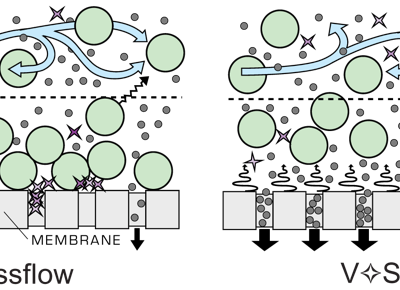
Moreover, membrane dehydration is a progressive concentration process. Conventional cross-flow filtration (spiral-wound, flat sheet and vertical membranes) easily accumulates highly concentrated coffee liquor on the membrane surface to form a dynamic fouling layer and reduce membrane flux.
Vibratory Separation Process (VSEP)
Over 30 years ago, Newlogic began researching the drawbacks of traditional membrane systems and developing targeted solutions. Researchers found that high-velocity cross-flow generates vibration and shear force within bulk fluid yet cannot effectively act directly on the membrane surface.
Newlogic therefore developed a unique vibration mechanism to create intense shear force right on the membrane surface. The customized membrane module features wide flow channels between membrane sheets to ensure unobstructed fluid passage without stagnation. A resonance drive system reciprocates the entire membrane assembly 50 times per second to eliminate inherent defects of standard cross-flow membranes.
The open feed channel enables unblocked liquid flow through filter elements while creating pressure differential between inlet and outlet. High-frequency vibration produces strong shear force on the membrane surface to prevent scaling, and flushes surface contaminants out along with concentrated liquor laminar flow.
In 2021, Rowan University (USA) partnered with Nestlé New Jersey Branch to conduct a series of tests on coffee extract concentration and dehydration using VSEP NF technology.
Reference links:
https://rdw.rowan.edu/etd/2909
https://engineering.rowan.edu/_docs/faculty/slater-coffee-wwt.pdf
https://engineering.rowan.edu/_docs/faculty/slater-coffee-conc.pdf
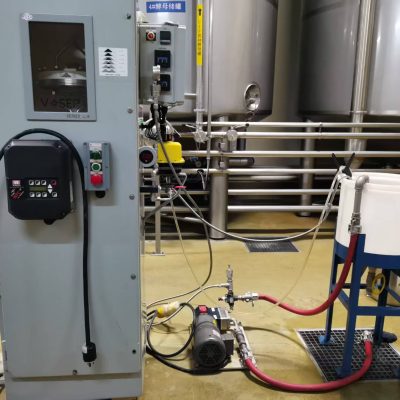
Also in 2021, Newlogic performed dehydration trials with VSEP RO to improve the reusability of clear permeate from coffee extract separation.
VSEP RO Test Data Table
表格
| Test No. | Sample | Solids Content | Conductivity | pH | Brix |
|---|---|---|---|---|---|
| Test 1 | Original Coffee Extract 1 | 11.51% | 2,000 µS/cm | 4.9 | 1.65° |
| VSEP Permeate | 0.01% | 260 µS/cm | 4.2 | 0.01° | |
| VSEP Concentrate | 20.95% | 37,000 µS/cm | 4.8 | 22.83° | |
| Test 2 | Original Coffee Extract 2 | 1.54% | 1,500 µS/cm | 3.7 | 1.68° |
| VSEP Permeate | 0.05% | 320 µS/cm | 3.0 | 0.07° | |
| VSEP Concentrate | 22.83% | 8,000 µS/cm | 4.3 | 24.84° | |
| Test 3 | Original Coffee Extract 3 | 2.63% | 2,000 µS/cm | 3.6 | 2.90° |
| VSEP Permeate | 0.03% | 340 µS/cm | 2.8 | 0.05° | |
| VSEP Concentrate | 22.48% | 7,400 µS/cm | 3.9 | 24.46° |
Single-stage VSEP RO operating at 500 psi (35 kgf/cm²) achieves a 10-fold concentration ratio with a 90% water recovery rate: 90% clean water is recyclable, and the remaining 10% becomes coffee concentrate.
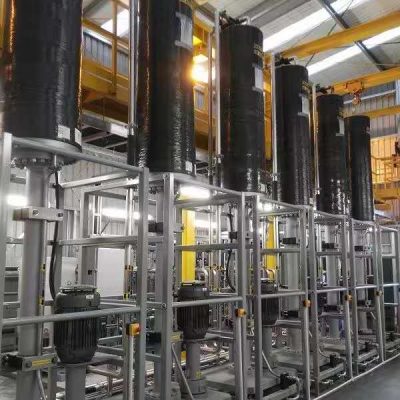
In 2023, Germany’s Jacobs Coffee purchased two sets of i84 VSEP systems for formal commercial operation.
VSEP Product Line
VSEP i18, i36 and i84 series have obtained 3-A Sanitary Standard certification compliant with US food grade requirements.
Supplementary Note: Membrane Dehydration for Freeze-Dried Coffee
Freeze-dried coffee retains the original flavor and aroma via lyophilization, whose workflow includes extraction, concentration, pre-freezing and sublimation drying. Pre-dehydration and concentration reduces free water for sublimation, shortens freeze-drying duration and boosts production efficiency. Generally, a 10% increase in solids content of concentrated liquor cuts the freeze-drying cycle by 20%.
Traditional concentration mostly adopts vacuum evaporation or high-temperature evaporation. Thermal concentration for freeze-dried coffee suffers from excessive energy consumption and severe flavor loss. In contrast, ambient-temperature membrane concentration avoids heat-induced colloid denaturation, delivers more uniform ice crystal distribution and forms a porous structure after sublimation. By comparison, viscosity fluctuation of thermally concentrated liquor disrupts ice crystal formation during freeze-drying.
Copyright Statement
This article is written by Sky Zhang from Newlogic, first published on the official WeChat account Coffee Raw Bean Warehouse.
Original source link: https://mp.weixin.qq.com/s/opViyQvSKosDED_sD5I1KQ
Reprint approved by the author.
Should you have demands for cost reduction via coffee extract concentration, please do not hesitate to contact us.



Comments (0)