
 中文
 English
Against the backdrop of increasingly stringent environmental regulations, qualified discharge or reuse of industrial wastewater has become a core priority for enterprises pursuing sustainable development. Nevertheless, wastewater streams feature complex and variable compositions, frequently presenting challenges such as elevated COD, high total dissolved solids (TDS), excessive heavy metal concentrations and refractory organic compounds. Conventional membrane treatment technologies suffer severely from concentration polarization, scaling and membrane fouling, which call for urgent solutions. Hasty procurement and deployment of wastewater treatment equipment without adequate technical verification often lead to low operational efficiency, out-of-control costs and difficulties in meeting discharge standards.
To help enterprises resolve wastewater treatment challenges in a targeted manner, our company has partnered with New Logic to deploy two sets of high-performance wastewater treatment test units, delivering lab-scale verification and on-site pilot testing services. This ensures your wastewater treatment solutions are scientifically sound, highly efficient and cost-effective.
Our test equipment is also applicable to other industrial fluid separation and processing scenarios, including phosphoric acid purification, waste acid & alkali recovery, brewer’s yeast recycling, and cold-brew coffee concentration.
I. Customized Test Solutions Tailored to Specific Wastewater Pain Points
Whether you are troubled by heavy metal overload in mining wastewater, extreme TDS levels in landfill leachate, or high COD loads from food manufacturing effluent, our test rigs can simulate mainstream core treatment processes and formulate customized test protocols based on your unique wastewater characteristics.
Lab-scale Bench Test
Clients provide 20 L to 100 L of wastewater samples for laboratory testing. Using our single-monolithic filter membrane unit, we rapidly screen and confirm the optimal membrane type, and obtain key indicators including contaminant removal rate, membrane flux and permeate water quality, so as to provide scientific evidence for solution feasibility.
Equipment configuration: Single Monolithic Filter Membrane
On-site Pilot Test
Testing is carried out directly at your production site to replicate real wastewater generation conditions. Continuous operation verifies process stability, equipment load capacity and operational costs, and delivers reliable design parameters (processing capacity, energy consumption, steady permeate quality, etc.) to support formal engineering implementation.
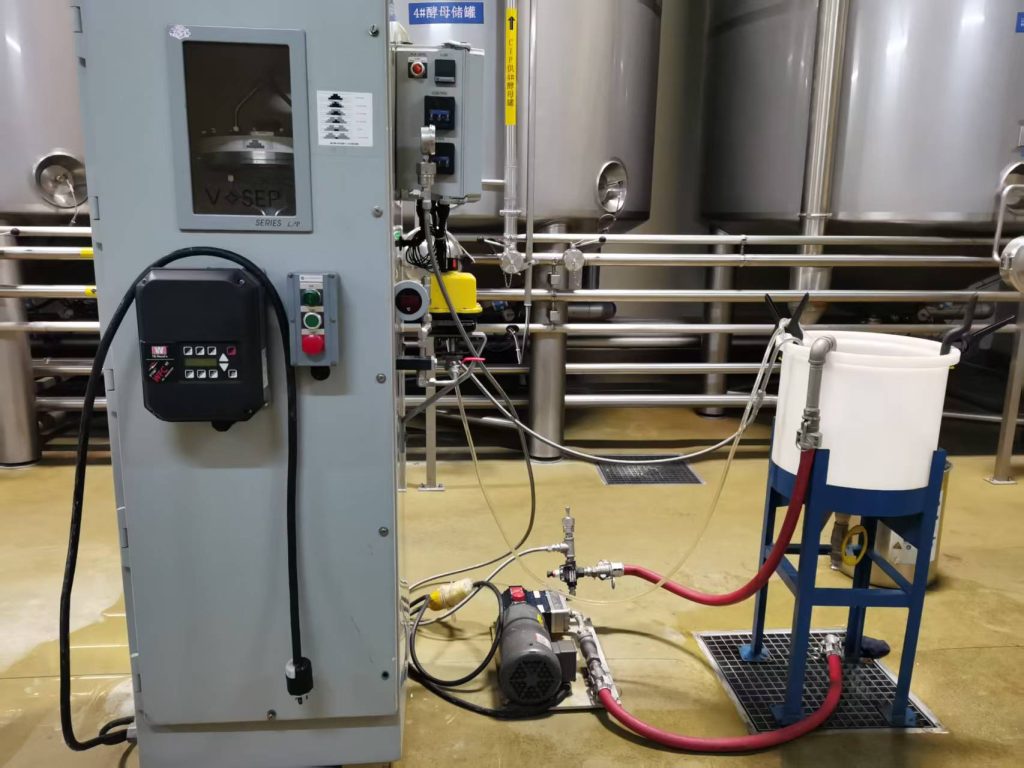
Equipment configuration: 38 pieces of filter membranes
On-site VSEP test equipment is shown in the figure below.
II. Reasons to Choose Our Testing Services
Precise Data to Mitigate Capital Investment Risks
Equipped with advanced test instruments and standardized operating procedures, our testing delivers a data error margin below 5%. Treatment performance can be accurately predicted. For hypersaline wastewater, pilot trials can quantify the anti-fouling performance and maximum water recovery rate (upwards of 90%) of the membrane system, preventing substantial financial losses caused by improper process selection.
Fast Response to Accelerate Project Timelines
A preliminary report for on-site bench testing can be issued within 3 to 5 working days. The duration of on-site pilot testing is flexibly adjustable between 7 and 15 days according to project requirements, enabling rapid decision-making for your projects.
Extensive Cross-industry Application Experience
Our technical team has years of in-depth experience in wastewater treatment and has provided testing services for clients across mining, chemical, municipal, food and other sectors. We specialize in complex industrial wastewater such as electroplating and pharmaceutical wastewater, and offer targeted optimization recommendations aligned with industry operational characteristics.
III. Standard Service Workflow
- Demand Communication: Clarify wastewater source, water quality parameters and treatment objectives
- Sample Analysis: Conduct component testing to identify primary pollutants
- Solution Design: Customize bench or pilot test plans and define experimental parameters
- Test Execution: Carry out bench or on-site pilot testing with real-time data monitoring
- Report Submission: Deliver a comprehensive report covering process recommendations, cost estimation and equipment selection guidance
From precise lab-scale validation to on-site practical pilot trials, our test equipment serves as a reliable litmus test for your wastewater treatment scheme.
Empower your environmental compliance decisions with authoritative test data, eliminate blind capital expenditure, and achieve both efficient wastewater treatment and optimized operational costs.
Contact us today to launch your customized wastewater treatment testing, and maximize the return on every environmental protection investment.
Hotline: (+86) 177-0158-2266
Service Email: jacob@sequoiaindustrial.com
Frequently Asked Questions
Q1: What is the typical timeline and cost for a VSEP on-site pilot test?
A standard VSEP on-site pilot test takes 7-14 days, including 2-3 days for equipment mobilization, 5-7 days for continuous testing, and 1-2 days for data analysis and report preparation. The cost ranges from $8,000-15,000 depending on wastewater volume, test duration, and membrane type required. This investment typically avoids $50,000-200,000 of wasted capital expenditure on incorrectly sized or misapplied treatment systems.
Q2: How does VSEP pilot testing differ from conventional laboratory jar tests?
Laboratory jar tests only simulate bulk fluid behavior and cannot predict membrane fouling under real concentration polarization conditions. VSEP pilot testing uses actual membrane elements (typically NF or RO, 2-5 m² active area) operating at full-scale pressure (20-40 bar) and vibration frequency (50-60 Hz), providing flux decay curves, fouling resistance data, and cleaning protocol validation that directly scales to full design — typically ±15% accuracy vs ±50-100% accuracy for bench-scale extrapolation.
Q3: What industrial wastewater types have been successfully treated by VSEP pilot tests?
VSEP pilot tests have been validated on: (1) Phosphoric acid purification wastewater — reducing TDS from 15% to <1% with 92% water recovery; (2) Brewery yeast supernatant — concentrating solids from 2% to 12% without fouling over 72 hours; (3) Cold-brew coffee concentrate — achieving 20-25% TDS at 15-20 LMH flux; (4) High-salinity leachate — concentrating 3x volume reduction with RO membranes at 30 bar.
Q4: How does pilot test data translate to full-scale engineering design?
The pilot generates three critical design parameters: (1) Steady-state flux at target concentration — directly scales to full membrane area calculation; (2) Fouling rate and cleaning frequency — informs membrane lifespan estimate (typically 3-5 years) and CIP schedule; (3) Specific energy consumption (kWh/m³ permeate) — predicts operating cost within ±20%. Full-scale systems typically use 40-80 m² membrane modules, and pilot-to-full scale flux correlation is 0.85-0.95 of pilot values due to flow distribution effects.
Related VSEP Technology Articles
- Application of VSEP Technology in Instant Coffee and Coffee Concentrate Production
- Summary of Vibratory Shear Enhanced Process (VSEP) Technology and Partial Applications
- VSEP for Landfill Leachate Treatment
- VSEP Vibratory Membrane Technology for High-Concentration Brine & Liquid Treatment




Comments (0)