Membrane-based separation technologies are widely deployed across industrial applications, yet each category bears distinct strengths and drawbacks. Conventional membrane technologies suffer from inherent limitations including severe membrane fouling and low permeate flux, driving excessive operational expenses and rendering such systems operationally inefficient. The VSEP Vibratory Membrane System engineered by NEW LOGIC (United States) specifically addresses the core deficiencies plaguing standard membrane treatment technologies and expands process options for end users.
1. Exceptionally High Permeate Flux
VSEP delivers filtration rates 10 times higher than competing separation technologies. Its standout advantages encompass precision filtration, superior permeate quality, controllable retentate volume (covering micron-scale to molecular-scale separation) and broad feedstock compatibility.
Building upon these competitive edges, New Logic has pioneered breakthrough membrane filtration technology to mainstream industrial adoption. To date, VSEP remains the sole filtration system capable of sustaining consistently high flux throughout single-pass filtration, regardless of suspended solids concentration in feed streams.
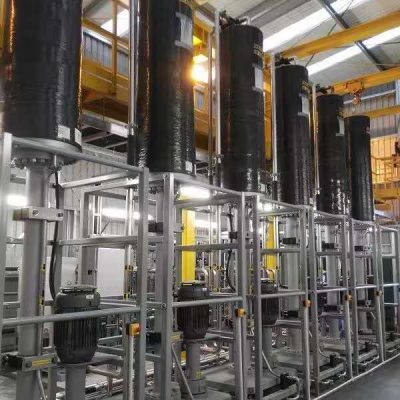
VESP 应用
2. Superior Anti-Fouling Performance
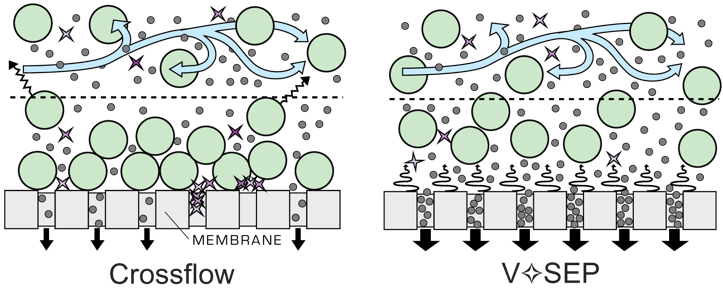
VSEP’s patented vibratory shear technology maintains continuous cleaning of membrane surfaces. Multiple core functional advantages exclusive to VSEP stem from this vibratory shear mechanism. The shear effect enables high-throughput separation spanning low-molecular-weight solutes up to 30-micron particulates, marking VSEP as the first and only equipment of its kind to deliver a genuine paradigm shift in filtration technology, retaining a multi-year technological lead over rival systems.
The ultra-high-frequency vibratory shear filtration mechanism delivers remarkable performance: intense shear waves propagating across membrane surfaces resolve long-standing membrane fouling challenges by scouring accumulated solids and contaminants off membrane surfaces. High-flux filtration is sustained even for feeds with ultra-high solid loading.
- No loss of target product (a critical drawback of centrifuges and filter presses);
- No requirement for coagulant additives (unlike rotary drum filters and clarifiers);
- Significantly reduced energy consumption (compared with evaporators and biochemical treatment units).
3. Treatment of High-Solids Wastewater
Single-pass filtration simplifies the entire separation workflow for high-solids wastewater streams. VSEP efficiently processes highly viscous feed suspensions with solid concentrations up to 70 wt%. Its operating principle is straightforward: shear waves generated by high-frequency membrane vibration repel suspended solids and contaminants, allowing unobstructed liquid permeation through membrane pores.
4. Exceptional Energy Efficiency
VSEP achieves an energy-to-shear force conversion efficiency of up to 99%.
At the heart of VSEP’s high-efficiency design lies a patented resonant drive system. It delivers concentrated shear force to discrete zones on membrane surfaces to maximize energy utilization, realizing efficient power conversion and minimal energy draw. A standard VSEP unit consumes less than 20 horsepower. Nearly 99% of input electrical energy is converted into surface shear force on VSEP membranes. By contrast, conventional cross-flow filtration systems only achieve a mere 10% energy conversion efficiency.
5. Robust, Reliable Design
With merely two moving components paired with a self-repairing membrane assembly, VSEP drastically cuts costly unplanned downtime. VSEP adopts a compact, fully enclosed simple design; its routine maintenance requirements are comparable to those of standard water pumps under typical industrial operating conditions. The unit starts up immediately upon power connection and consistently produces high-purity permeate.
VSEP’s two sole moving parts include:
- Torsion springs: proven to deliver indefinite service life;
- Self-lubricating bearings.
Complemented by a patented redundant membrane system that automatically compensates for failed membrane elements, the design guarantees uninterrupted continuous operation.
6. Ultra-Compact Footprint
A standard VSEP unit occupies only 16 square feet of floor space, outperforming competing systems that demand 10 to 100 times larger footprints.
A single VSEP module occupying just 20 square feet delivers a total membrane area of 1,500 square feet. Alternative membrane systems require 10–100 times more floor area to achieve equivalent membrane surface area. The modular architecture supports seamless capacity expansion, and installation of the Series i VSEP units is as straightforward as installing a standard water pump.
7. Convenient Testing Services
We provide full-spectrum testing support, ranging from lab-scale small-sample trials to pilot-scale demonstration runs.
Front-end laboratory testing prior to capital investment delivers substantial cost savings. New Logic can process customer feedstock on our in-house test equipment to define baseline operational parameters and budget estimates. Testing workflows are streamlined equivalent to initial small-sample screening. Upon test completion, New Logic issues comprehensive test reports and delivers physical samples of permeate and retentate to clients (sample delivery is optional per customer requirements). Additional testing options include:
- Client rental of bench-scale L/P model units for independent data collection;
- Customer site visits to New Logic’s humidity-controlled pilot testing facility, where feedstock can be processed to simulate full-scale industrial operating conditions.
8. Low Total Cost of Ownership
Cost reductions stem from minimized energy expenditure, reduced maintenance labor and shortened processing cycles. Coupled with VSEP’s exclusive proprietary functional advantages, its outstanding operating cost ratio delivers the lowest total cost of ownership among comparable separation systems:
- High flux maximizes production output per unit capital expenditure;
- Anti-fouling performance reduces membrane replacement frequency and cuts cleaning/maintenance overheads;
- Single-pass high-solids separation streamlines end-to-end process workflows;
- Energy-efficient operation slashes continuous operational expenses;
- Reliable mechanical design eliminates costly production downtime;
- Compact footprint simplifies installation and saves valuable plant floor space;
- Flexible pre-investment testing mitigates technical risks.
All integrated advantages position New Logic VSEP as the most cost-competitive membrane separation solution available.
9. Application Sectors
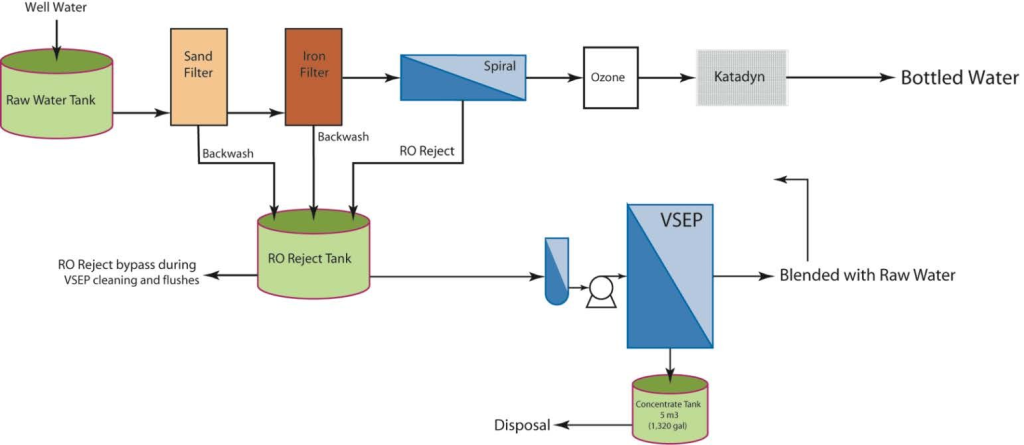
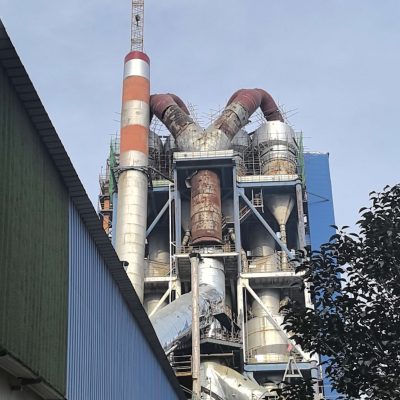
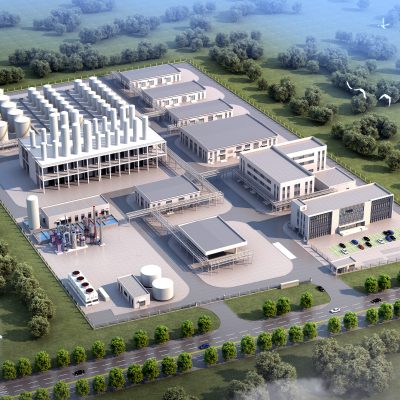
VSEP excels in treating complex industrial fluid streams including high-salinity wastewater, flue gas desulfurization wastewater, landfill leachate and industrial waste liquor, while also featuring extensive applicability in food & beverage deep processing. Compared with traditional spiral-wound membrane systems, VSEP delivers distinct operational cost advantages, validated by numerous successful domestic and international industrial reference projects.
Within the new energy industry, VSEP delivers substantial economic benefits across core process workflows, including phosphoric acid purification and lithium extraction from salt lake brines.
To facilitate client feasibility testing, we maintain a dedicated pilot test platform. By installing basic piping and storage vessels at project sites, clients can conduct 7×24-hour continuous industrial pilot trials. Trials generate primary experimental datasets directly applicable to full-scale engineering design, substantially mitigating project technical risks and operational uncertainties.
Frequently Asked Technical Questions
Q1. Why can VSEP concentrate brines far beyond the TDS ceiling of spiral-wound RO?
Conventional spiral RO is solubility-limited, not pressure-limited. As concentrate flows down a 40-inch element, axial cross-flow shear (~1,000–5,000 s⁻¹ at the wall) cannot prevent a solute-rich boundary layer, so the membrane-face concentration becomes 2–4× the bulk value. At bulk TDS of 40,000–60,000 mg/L, the face concentration crosses the gypsum, silica or NaCl saturation line and scale precipitates directly on the polyamide — spiral RO therefore tops out around 60,000–80,000 mg/L concentrate even with antiscalants. VSEP attacks this at the mass-transfer step: the flat-sheet discs are oscillated torsionally on a resonant spring-mass system at 50–60 Hz (resonance ~60.75 Hz) with 5–10 mm edge amplitude, generating wall shear rates of 100,000–150,000 s⁻¹ — roughly 200 g acceleration impulses as direction reverses. The CP layer is stripped on each half-cycle, so face concentration ≈ bulk concentration. Any precipitation that does occur happens in the well-mixed bulk flow, where suspended solids act as nucleation sites, rather than as a hard scale on the membrane. New Logic quotes feed tolerance up to TDS 100 g/L (100,000 mg/L), pH 0–12, temperature ≤60 °C, with TMP to 70 bar (1,000 psi). Osmotic pressure — not solubility — becomes the only hard limit, which is why VSEP is described as a ‘controlled membrane crystallizer’.
Q2. What flux, recovery and final concentrate TDS are demonstrated on high-strength brines?
VSEP brine service is typically placed downstream of a conventional 70–85% recovery RO, taking the 30,000–55,000 mg/L RO reject and pushing it to 85–95% overall system recovery. On the Indiana coal fly-ash case (feed ~10,000 µS/cm, ~1% total solids) VSEP held 93% recovery with permeate conductivity 365 µS/cm and sulphate <200 mg/L, with no pretreatment beyond screening. On sodium-sulphate-rich streams (battery / colloidal silica wastewater), VSEP NF at ~150,000 s⁻¹ shear concentrates the brine to near-crystallizer-ready TDS. Permeate flux on these brine duties typically runs 10–25 LMH (≈6–15 GFD) at TMP 40–60 bar; on less fouling brackish feeds flux climbs to 30–50 LMH. The key benchmark is final concentrate quality: spiral RO leaves you at ~7–8 wt% dissolved solids; VSEP routinely reaches 12–18 wt% (120,000–180,000 mg/L) before osmotic pressure equals the 70-bar pump limit, and on actively precipitating salts can deliver crystallizer feed directly. Desalination salt rejection is 95–99% on a brackish RO membrane and 98.5–99.5% on a high-rejection seawater-grade element. Cleaning frequency drops from weekly acid/alkali CIP on spiral RO to hot-water flush every 4–8 hours plus chemical CIP roughly once weekly.
Q3. How does VSEP specific energy and CAPEX compare with MVR / evaporator brine concentration for ZLD?
The economics of ZLD are dominated by the evaporator, which carries CAPEX of roughly $100,000–200,000 per m³/day and energy of 15–40 kWh/m³ of water evaporated (mostly in steam equivalent). VSEP is an electrical, non-thermal process: because the torsional oscillator runs at mechanical resonance, its drive motor only supplies damping losses — typically 0.5–2 kWh/m³ attributable to vibration, plus 2–4 kWh/m³ for high-pressure feed pumping. Total specific energy for a VSEP brine concentrator at 85–90% recovery is therefore 4–8 kWh/m³ of permeate, roughly one-fifth to one-quarter of MVR. Installed CAPEX for a skid-mounted VSEP brine unit is roughly $40,000–80,000 per m³/day of permeate capacity, depending on pressure rating and alloy wetted parts. The standard ZLD train is ‘conventional RO → VSEP brine concentrator → small MVR crystallizer’: pushing VSEP recovery to 90% cuts evaporator feed volume by ~5× versus a spiral-only train, which typically removes 40–60% of ZLD plant CAPEX and 50–70% of thermal energy. Payback on the VSEP skid alone, counted against avoided evaporator CAPEX and steam, is commonly 2–4 years; on sites with electricity-to-steam ratios favourable to membranes (low-cost hydro/wind power), it can drop below 2 years.
Q4. How is a VSEP brine concentrator scaled up from lab bench to industrial skid, and how are disc stacks configured?
New Logic uses a three-step scale-up protocol. Lab stage: a bench VSEP with ~0.05–0.2 m² of flat-sheet disc area screens NF (MWCO 150–400 Da), brackish RO and seawater RO elements at TMP up to 70 bar on site brine for 2–6 weeks, measuring flux decay, scaling tendency and permeate TDS. Pilot stage: a trailer-mounted vibrating stack with 10–20 m² active area runs on site for 4–12 weeks to confirm long-term CIP interval and membrane life. Full-scale stage: commercial i18 and i36 skids carry 18 m² and 36 m² per vibrating disc stack, all discs mounted on a single vertical torsion shaft oscillated at 50–60 Hz. For a 50–200 m³/day brine concentrator, stacks are typically arranged in two stages: a first bank in parallel at 40–50% stage recovery, then a second high-pressure bank (60–70 bar TMP) in series for the final 80–90% overall recovery. The flexible leaf-and-gasket disc design tolerates the 200 g cyclic shear without the element fatigue seen in spiral at similar shear, and membrane swap is a mechanical stack-open rather than a vessel cut. A typical 200 m³/day skid therefore uses 4–8 i36 stacks on a common base, with CIP tank, high-pressure multistage pumps and PLC integrated.

 中文
 English



Comments (0)